The DJI Matrice 400 (M400) is shaping up to be the drone giant’s next powerhouse in enterprise UAVs. Leaked specs and images in early 2025 have ignited excitement among drone professionals and enthusiasts alike. With DJI Enterprise even teasing a new release on June 10, 2025, under the slogan “Engineered for Excellence, Designed for Versatility,” all signs point to the M400 as a game-changing successor in DJI’s Matrice lineup.
This upcoming drone is rumored to build upon the Matrice 300/350 series’ legacy with heavy-lift capability, extended flight endurance, and advanced sensors tailored for industrial applications. Below, we dive into the latest credible information – from official hints to insider leaks – and compare the Matrice 400 to its predecessors in terms of features, improvements, and use cases.
Official Teasers and Credible Leaks
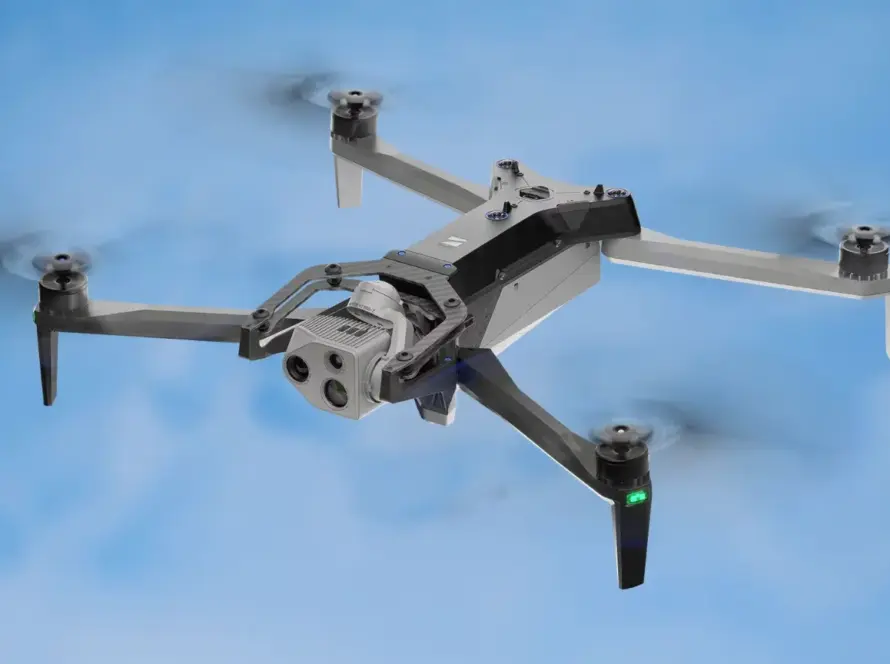
DJI’s official channels have kept details sparse, but a recent DJI Enterprise teaser (set against a sunrise and a transmission tower) offers a few clues. The teaser image shows a drone with a prominent dome-like sensor module at its center and at least two visual sensors at the corners. This aligns with leaks suggesting the Matrice 400 will carry an integrated 360° LiDAR or similar advanced sensor on top, likely protected by a clear dome. In fact, well-known DJI leaker Igor Bogdanov (@Quadro_News) shared photos of a test M400 unit – revealing a large dome mounted on the drone’s back and confirming the presence of a new sensor system. Additional images leaked on LinkedIn by Mickael Gay (CEO of Group Actibot) give a closer look at the M400’s design. These show a sturdy carbon-fiber airframe with folding arms (resembling the Matrice 300/350 series) and multiple obstacle avoidance cameras for all-directional sensing. Notably, the drone was photographed in a folded configuration with an unknown payload attached, indicating compatibility with interchangeable gimbals or sensors loyaltydrones.com.
DJI’s official teaser (June 2025) hints at the Matrice 400’s inspection prowess – note the dome-like top sensor and the tagline “Engineered for Excellence, Designed for Versatility.”
Several FCC filings and spec leaks have corroborated these visuals. In late 2024, a filing for a “DJI M400A” hit the FCC database, strongly indicating an imminent release. The FCC label leak revealed a massive battery pack (details below) and the “M400A” designation – the “A” suffix suggests multiple variants of the Matrice 400 could be planned. Industry observers speculate this might mean different versions (perhaps an RTK model, or region-specific variants) will be launched to cater to various enterprise needs. DJI has a track record of using FCC filings as a prelude to product launches within 1–2 months, and indeed the official event on June 10, 2025 is expected to unveil the M400 formally.
Hefty Battery and Heavy-Lift Power
One of the most striking leaked specs is the enormous battery the Matrice 400 will use. The FCC documents and multiple reports show the M400’s battery labeled at 20,254 mAh, 48.23 V, delivering about 977 Wh of energy. This is a massive jump compared to the dual TB65 batteries (~263 Wh each, ~526 Wh total) on the Matrice 350 RTK or the TB60 pairs (~TB60 has ~274 Wh each) on the Matrice 300 RTK. In fact, it’s a ~244% capacity increase over the Matrice 350’s battery, immediately signaling that the M400 is not just a straight successor to the 350 but a different beast altogether. For further perspective, the Matrice 600 Pro’s six-pack battery system provided a total of 780 Wh; the M400 surpasses that with a single pack, underlining DJI’s intent to target the heavy-lift segment previously served by the M600.
Such a high-capacity battery promises significantly longer flight times – likely well beyond the ~45-55 minutes that the M300/350 could max out at. Endurance of over an hour might be feasible depending on payload, which would be a huge boon for mapping large areas or lengthy infrastructure inspections in one go. Moreover, the high voltage (48V) design suggests a more efficient power system to drive the motors and onboard electronics. Industry analysts estimate the M400’s battery alone could weigh around 5 kg, and the drone’s takeoff weight might approach ~9–10 kg (around 20 lbs) including the battery loyaltydrones.com. This puts the Matrice 400 in a significantly heavier class than the ~7.5 kg Matrice 350 RTK (with batteries) and indicates robust lifting power.
Heavy-lift capacity: Thanks to this power boost, the Matrice 400 is expected to carry much heavier payloads than its predecessors. While the Matrice 300/350 are rated for ~2.7 kg of payload, the M400 is rumored to handle around 10 kg of payload loyaltydrones.com. That would rival or exceed the older six-rotor Matrice 600 Pro (which could carry ~5.5–6 kg comfortably) and approach the level of specialized agricultural drones. Realistically, insiders predict ~10 kg (22 lbs) payload capacity for the M400, positioning it as a true heavy-lift platform for tasks like carrying multiple sensors or larger equipment. DJI’s use of lightweight materials and powerful motors will determine the exact figure, but clearly the M400 aims to fill the heavy-duty role in DJI’s lineup – effectively succeeding the M600 Pro for industrial lifting needs.
Single battery vs. dual batteries: Unlike the Matrice 300/350 which use dual redundant batteries, the leaked images of the Matrice 400 show one huge battery bay in the center of the drone igeekphone.com. DJI appears to have designed a single high-capacity pack (possibly named TB100) rather than two smaller packs. This approach has pros and cons. On one hand, a single battery simplifies installation and maintenance – just grab one pack and go – and likely reduces the drone’s overall weight compared to having additional casing and circuitry for two batteries. On the other hand, enterprise operators have voiced safety concerns about the lack of redundancy. With two batteries, the Matrice 300 could survive one pack failing and even hot-swap batteries between flights; with one battery, a failure means immediate loss of power. “Massive battery. No redundancy? Only one battery?!” one colleague remarked in response to the leaked photos. The absence of a backup power source has raised questions about meeting strict safety requirements for certain missionsigeekphone.com. For example, in some regions like Europe, drones over 900 g are required to have safety features like parachutes or redundant power to fly over people or urban areas. Regulators may scrutinize the M400’s design if no redundancy is present. It’s possible DJI has some mitigation – e.g. an internal auxiliary battery for brief power fails or hot-swap – but no such feature has been confirmed yetloyaltydrones.com. Despite the debate, many agree the single battery design underscores DJI’s confidence in the new pack’s reliability and the emphasis on maximum flight time and lift capacity.
Advanced Sensors and Technology Integration
Beyond brute power, the Matrice 400 is rumored to be loaded with advanced tech, making it a flying sensor powerhouse. Perhaps the most buzzworthy feature is the integrated LiDAR system. According to the leaked info and photos, the M400 has a LiVOX 360 LiDAR unit mounted on top of the airframeigeekphone.com. This is a significant addition – LiVOX is DJI’s compact LiDAR module (seen in products like the Livox Horizon), and having a 360° laser scanner onboard would allow the M400 to generate high-resolution 3D point clouds of its surroundings. For industries like surveying, construction, and emergency response, an inbuilt LiDAR means out-of-the-box 3D mapping and obstacle detection capabilities. Mickael Gay, who shared the leaked photos, highlighted the drone’s “sturdy fuselage and a LIVOX 360 mounted on top” as a major plus “for those passionate about LiDAR, cartography and inspection”igeekphone.com. In other words, the Matrice 400 is expected to excel at tasks like detailed terrain modeling, infrastructure scanning, and autonomous navigation in complex environments.
In addition to LiDAR, the M400’s design shows multiple stereo vision sensors (or cameras) for obstacle avoidance. The teaser clearly hints at pairs of cameras on the drone’s corners, which likely give it 360-degree obstacle sensing similar to or better than the Matrice 300’s system. DJI Enterprise drones already use vision sensors to enable features like waypoint obstacle avoidance and object tracking; the M400 will likely advance this further for safe autonomous flight around power lines, structures, and in tight spaces. The improved obstacle sensing is in line with DJI’s focus on inspection drones that can maneuver with minimal pilot intervention even near hazardous structures. Combined with LiDAR (which can provide precise distance maps of obstacles), the M400 could set a new benchmark for autonomous navigation and safety in enterprise operations.
Another rumored upgrade is in the communications and control department. An FCC filing referenced a mysterious “M400 RC sub-2G SDR module,” which appears to be a sub-2GHz software-defined radio unit for the M400’s remote controller. Experts interpret this as DJI adding long-range, lower-frequency communication capability to the Matrice 400. Traditional DJI drones use 2.4 GHz and 5.8 GHz bands (high bandwidth but shorter range), whereas a sub-2GHz link (in the ~900 MHz range) can penetrate obstacles and maintain connection at much longer distances. This points to DJI preparing the M400 for BVLOS (Beyond Visual Line of Sight) missions – for example, inspecting remote pipelines or power lines where the pilot might be far from the drone. The SDR aspect means the controller could dynamically switch frequencies or comply with various regional bands, making the system flexible and robust against interference. In practical terms, the M400 might use the regular OcuSync video link on 2.4/5.8 GHz but have a redundant control/telemetry link at 900 MHz for backup or extended range. This kind of dual-link architecture would greatly increase reliability for critical operations – if true, it’s a noteworthy improvement over the Matrice 300 series’ communications.
Payload and sensor compatibility: Being a platform drone, the Matrice 400 is expected to support a variety of payloads. DJI hasn’t leaked any specific new camera, but it’s safe to assume the M400 will work with the existing Zenmuse enterprise gimbal cameras (H20/H20T series, P1 photogrammetry camera, L1 LiDAR module, etc.) and possibly new payloads yet to be announced. In fact, some leaked images showed a payload attached under the drone, hinting at a new camera or sensor in developmentloyaltydrones.com. Drone forum discussions are buzzing with hopes that DJI might introduce an upgraded hybrid camera – for instance, a higher resolution thermal sensor (one user speculated a jump to a 1280×1024 thermal imager from the current 640×512) along with improved zoommatricepilots.com. Others expect enhanced night-vision and low-light capabilities, perhaps leveraging technology from the smaller Matrice 4E/4T series (which feature starlight sensors and laser rangefinders)matricepilots.com. There’s also talk of onboard AI for object recognition and tracking, building on DJI’s implementation of AI Spot-Check and automated inspection routines in the M300matricepilots.com. While much of this remains speculative, DJI’s teaser tagline “Designed for Versatility” hints that the M400 will be a multi-mission platform – likely able to carry gimbals on both its belly and possibly on top (like the M300 could) to use tools like upward-facing cameras. The robust build and ample power mean the M400 could even carry multiple payloads at once (e.g. a zoom camera, a thermal camera, and a gas detector simultaneously), streamlining complex operations that currently might require two separate drones.
Matrice 400 vs. Matrice 300/350 (and Other Drones)
How does the Matrice 400 compare to its predecessor, the Matrice 300 series, and other DJI enterprise drones? The differences are shaping up to be significant:
- Battery & Flight Time: The Matrice 300/350 uses dual batteries (~526 Wh total) for up to ~55 minutes of flight, whereas the Matrice 400’s single battery is 977 Wh – nearly double the energy. This suggests the M400 will far exceed the M300’s flight endurance. Longer missions and less frequent battery swaps mean higher efficiency for operators. However, unlike the M300’s redundant batteries, the M400’s single pack means no hot-swapping and potentially less fault toleranceigeekphone.com. Users will trade redundancy for extended airtime with the M400.
- Payload Capacity: The M300/350 is rated for ~2.7 kg payload (enough for one or two lightweight sensors). The M400 is rumored to lift around 9–10 kg, an astounding leap that puts it in a different class entirely. This opens the door for heavy gear – for example, larger LiDAR units, multi-sensor payloads, or even small cargo delivery. It essentially brings Matrice 600 Pro-level lifting power to a more modern platform. For jobs like carrying a high-end cinema camera or a long-range zoom plus a spotlight, the M400 would handle it with ease (something the M300 struggled with due to weight limits).
- Size & Form Factor: Both the M300 and M400 are quadcopters with folding arms for transport. The leaked M400 appears a bit larger and heavier (estimated ~10+ kg takeoff weight with battery, vs ~9 kg for an M300 with batteries)loyaltydrones.com. Construction is carbon fiber on both. We can expect the M400 to have a similar folding design that fits into cases, albeit the case might be larger given the bigger battery and frame. Portability is slightly sacrificed for capability in the M400.
- Sensors & Avionics: The Matrice 300 came with advanced features like six-direction obstacle sensing, an ADS-B receiver (AirSense), and support for triple gimbal mounts. The Matrice 400 will likely retain ADS-B In and similar safety features, but ups the ante with built-in LiDAR mapping and possibly more comprehensive obstacle avoidance (the teaser showed at least 8 optical cameras total for obstacle sensing). This could mean even more reliable autonomous flight and object detection than the M300’s already-impressive system. The M400 should also include an RTK module for centimeter-level positioning (the M300 was sold as the “RTK” model standard), which is crucial for precision mapping and inspection – leaks have not explicitly mentioned RTK, but it’s almost certain in an enterprise drone of this caliber.
- Communication: Both drones use DJI’s OcuSync Enterprise for control and video, but the M400 adds the 900 MHz SDR module for extended range/beyond-line-of-sight control. In essence, M400 pilots could maintain link quality over longer distances or in obstructed environments where the M300 might drop out. This is a big plus for operations like linear infrastructure inspection (railways, pipelines) where keeping within a few kilometers was challenging with previous tech.
- Use Case Focus: The Matrice 300/350 is a general-purpose workhorse for public safety, survey, and inspection. The Matrice 400, while certainly multipurpose, appears especially tailored for heavy-duty inspection and mapping roles. The presence of LiDAR and the long flight times suggest it’s ideal for jobs like mapping large areas, scanning tall structures, and carrying specialized payloads that the M300 couldn’t. In fact, rather than replacing the Matrice 350 RTK directly, the M400 seems to target a higher tier – “moving away from the 350 and into the market of the Matrice 600 Pro,” as one analysis put it. We might see the Matrice 350 RTK continue to serve users who need a mid-size drone, while the M400 becomes the choice for maximum endurance and payload needs.
- Other DJI Enterprise Drones: It’s worth noting where the M400 sits relative to DJI’s newer Matrice 4 series (M4E and M4T) and others. DJI recently introduced the Matrice 4E/4T – compact drones (roughly Mavic 3 size) with integrated zoom/thermal cameras for quick deployment. Those “M4” models, despite the name, are much smaller (under 4 kg) and carry far less payload, focusing on portability and AI features for inspection. The Matrice 400 is in a different league – larger, more powerful, and not an all-in-one sensor package but a configurable platform. For example, the M4T has a built-in thermal camera and ~40 min flight, whereas the M400 can carry a high-end thermal camera (or multiple cameras) and fly longer, but requires that you attach the desired payload. Similarly, DJI’s Agras agricultural drones (like the T25) have heavy lift capacity and big batteries, but those are built for spraying crops. The Matrice 400 is more versatile in payload: you could use it for spraying or spreading (with appropriate attachments) one day, then mount a LiDAR scanner the next day for surveying – something dedicated ag drones or the smaller M4E/T cannot do. In summary, the DJI Matrice 400 stands out as the flagship enterprise platform for 2025, combining the best of prior heavy-lift drones (like M600’s strength) with the intelligence and autonomy of modern quadcopters (like the M300 series).
Applications and Use Cases
The rumored features of the Matrice 400 suggest it will unlock new possibilities across various industries. Here are some key applications and how the M400 could excel in them:
- Infrastructure Inspection: Power lines, cell towers, wind turbines, bridges – these are classic inspection targets for drones, and the M400 appears purpose-built for them. The teaser’s backdrop of a transmission tower was no coincidence. With its long flight time and long-range comms, an M400 can inspect extended stretches of power grid or multiple towers in one flight. The 360° LiDAR and enhanced obstacle sensors mean it can autonomously keep a safe distance from wires and metal structures while scanning them in detail. High-res cameras (like a Zenmuse H20 series) combined with LiDAR would allow creation of 3D models of infrastructure and detection of faults (e.g. sagging lines or damage) without putting humans at risk. Utilities and telecom companies will appreciate how the M400 could reduce or replace dangerous manual climbs – an inspection that might take a crew hours of climbing could be done by the drone in minutes, with zero safety risk. And because it’s “engineered for excellence and versatility,” the same drone might carry a thermal camera to check for overheating components, then switch to a zoom camera for close visual inspection, all in one mission.
- Aerial Surveying and Mapping: Surveyors and GIS professionals often need to map large areas or create high-accuracy 3D models. The Matrice 400, with integrated LiDAR and RTK, is poised to be a powerhouse for aerial mapping. It can cover more ground per flight than smaller drones, thanks to the big battery, and capture millions of LiDAR points to generate precise 3D terrain maps or building models. Photogrammetry missions (using a camera like the Zenmuse P1 or a future high-res camera) will benefit from the stable platform and long endurance – fewer battery swaps means more consistent lighting and faster completion of large-area scans. Additionally, the M400’s heavy lift opens the door to carrying both a LiDAR and a high-megapixel camera concurrently, collecting LiDAR point clouds and high-res imagery in one sortie for comprehensive mapping data. This could dramatically streamline workflows in construction site monitoring, urban planning, and environmental surveying. With centimeter-level RTK positioning on board, the data quality would meet strict survey standards without requiring ground control points in many cases.
- Public Safety and Search & Rescue: DJI’s Matrice series has been a staple for police, fire departments, and SAR teams. The Matrice 400 would continue this but with new advantages. Firefighting and disaster response could leverage its ability to carry heavy payloads: for instance, mounting a powerful spotlight and loudspeaker alongside a thermal camera. The M400 could hover over a scene for longer, providing overwatch at night with thermal imaging (to find hotspots or people) and illuminating areas for ground teams. In search-and-rescue, the drone’s extended range (possibly aided by the 900 MHz link) could allow it to go farther downrange in rural or wilderness searches, while relaying critical video back. Its heavy lift might even allow carrying and dropping small supply packages (first aid, phone, radio) to stranded persons in areas where a helicopter rescue is difficult. Moreover, the improved AI and sensing could help in automatic subject recognition – e.g. detecting human shapes or vehicles from the air and alerting the operator, similar to how DJI’s smaller drones use AI identification. With the M400’s computing and sensor suite, one can imagine it mapping out a collapsed building in 3D with LiDAR to aid firefighters, or tracking a missing person under forest canopy that smaller drones can’t penetrate (the combination of thermal and LiDAR could potentially see through gaps in foliage). In summary, for public safety agencies, the Matrice 400 promises greater endurance, payload flexibility, and autonomous capabilities, meaning more effective missions and potentially lives saved.
- Industrial Inspection and Engineering: Beyond power lines and telecom, industries like oil & gas, railroads, and infrastructure construction will find the M400 useful. Its heavy-lift capacity could allow it to carry specialized NDT (non-destructive testing) sensors, gas leak detectors, or even tools to physically interact (some drones carry small robotic arms for tasks like turning knobs or attaching sensors – the M400 could lift those). For example, inspecting a flare stack on an offshore oil rig might involve thermal imaging and gas sensing; the M400 could take off from a vessel, fly out and circle the structure performing all measurements in one go. The high wind resistance expected of a larger drone will help in such harsh environments. In construction, the drone could haul LiDAR and photogrammetry cameras to monitor progress and measure stockpile volumes on large sites. With its high precision and stable flight, it could even be used to carry out tasks like stringing guide lines (some drones have been tested to pull wires across ravines or between towers – a heavier drone can handle a thicker, longer line). Essentially, any industrial task that was borderline for the M300 due to flight time or weight limitations might become feasible with the M400.
- Agriculture and Environmental Management: While DJI has the Agras line for crop spraying, the Matrice 400 could find a niche in agriculture research and environmental management. It could carry multi-spectral or hyper-spectral sensors that are often heavier and require longer flight times to cover large farms or forests. With 10 kg lift, one could mount a truly advanced multi-sensor rig (for example, a combination of RGB, multispectral, thermal, and even a small LiDAR) to gather a rich dataset in one flight for precision agriculture analysis. Forestry agencies might use the M400 to lift seed dispersal payloads or to carry equipment to the canopy. And because it’s modular, after using it for mapping fields one day, a team could swap batteries and use it to haul emergency supplies or conduct a search operation in a rural community the next. The versatility is a big selling point – it’s not a single-purpose drone.
- Media and Cinematography: Although not the primary target market, the Matrice 400’s heavy lift and stability could attract high-end aerial cinematographers. The older Matrice 600 was popular in Hollywood for carrying large cinema cameras (RED, ARRI) on a gimbal. The M400 could potentially fill that role with more modern flight tech. Its single battery and quadcopter design are simpler than the hexacopter M600, but with similar (or better) lift capacity. If DJI or third-party adapters allow mounting a standard gimbal ring, the M400 could carry a full-frame camera or even a LiDAR-based focus system for film production. The advantage over Inspire 3 (which has an integrated camera) is that the M400 could use any camera up to a certain weight. Its flight time would also be better than the M600 (which typically got ~15-20 minutes with a heavy camera) – the 977 Wh battery might allow the M400 to fly a cinema rig for 30+ minutes, which is a huge improvement for filmmakers. Again, DJI hasn’t announced anything on this front, but it remains a possible use case given the drone’s specs.
In all these scenarios, a common thread is that the Matrice 400 offers longer operational range and time, heavier payload options, and greater autonomy. This translates to higher efficiency (cover more area or tasks per flight) and increased safety (keep human operators further away from hazards, and let the drone handle complex flying).
Industry Reception and Expert Insights
Even before its official release, the Matrice 400 has been a hot topic in drone communities, forums, and among tech journalists. The general sentiment is a mix of anticipation for its capabilities and caution about certain design choices.
Community excitement: On forums like DJI’s Matrice Pilots and Reddit, enterprise drone operators are eagerly trading rumors. Many see the M400 as a much-needed advancement for heavy-duty drone work. “With DJI’s innovation… an M40 series will be here soon enough,” one user noted optimistically, expecting features like an improved thermal camera, better night vision, and onboard AI for the new Matricematricepilots.com. The prospect of having an all-in-one mapping drone with LiDAR has surveyors excited, as it could eliminate the complexity of third-party LiDAR mounts and integrations. Public safety users are discussing how the longer flight times and possible BVLOS communications might allow them to finally attempt beyond-line missions legally, once regulations catch up. There’s also buzz about the M400 possibly replacing the aging Matrice 600 Pro in many fleets – as one LinkedIn user quipped, it may be time to retire the old hexacopters if the quadcopter M400 can do the same job with less hassle.
Expert and journalist insights: Drone industry journalists like Haye Kesteloo and Josh Spires (DroneXL) and Ishveena Singh (DroneDJ) have analyzed the leaks and weighed in. Their reports underline that the Matrice 400 is “one of DJI’s most power-packed drones to date” with capabilities that could “mark a major leap forward for industrial operators”. The inclusion of LiDAR is seen as part of a broader trend of drones becoming more specialized and integrated for tasks – essentially providing out-of-the-box solutions rather than requiring add-ons. Analysts note that DJI is aligning the M400 with the growing demand for autonomous inspection solutions. “Inspection drones are increasingly replacing manual methods, which are often costly and dangerous,” DroneXL writes, emphasizing how a versatile drone like this can improve safety and cut costs by significant margins. The teaser’s focus on an inspection use-case also suggests DJI knows where the market hunger is: infrastructure and industrial inspections are booming as assets age and need frequent surveys.
Praise and concerns: Mickael Gay (who provided the leaked images) praised the M400’s robust design and LiDAR capability, implying it could become a top choice for professionals in mapping and inspectionigeekphone.com. Enterprise users love to see the larger battery too, since flight time is money – more airtime per flight can dramatically improve project efficiency. However, experienced pilots and DJI dealers have also voiced some reservations. The biggest talking point, as mentioned, is the single battery design. Hugues Calderero, an expert in France, pointed out that European drone rules may pose a challenge: in France, for instance, drones over 900 g used in cities require safety add-ons like parachutes and independent kill switches. A heavy drone like the M400 with a single power source might face stricter certification requirements or need an aftermarket safety parachute to comply with such laws. Another professional, Jean Olivier Weber, commented on the changing regulations in Europe requiring drones to be “certified” (type-approved) for certain operations, which could impact adoption of a new model until it meets those standards. In the US, commercial operators are noting that while 55 lbs (25 kg) is the FAA’s upper limit for routine drone ops (and the M400 should stay under that), any flight over people or beyond line of sight will still need waivers or future rule changes. The timing of DJI’s launch is interesting in this context: the FAA is gradually opening up more pathways for advanced operations (they recently allowed some 5 GHz control links, for example), and the M400 seems built to take advantage of these evolving rules.
Overall, the Matrice 400 is garnering very positive early impressions for its technical prowess. It’s seen as a natural next step in the evolution of DJI’s enterprise drones – one that could keep DJI well ahead of competitors in the high-end segment (companies like Freefly, Acecore, and event Autel have offerings, but DJI’s integration and ecosystem might be unparalleled with the M400’s launch). The few points of concern (battery redundancy, regulatory hurdles) are likely to be addressed or mitigated over time, either by DJI or third-party solutions, given the drone’s target market.
As we await official confirmation, the DJI Matrice 400 already looks poised to redefine what’s possible in 2025’s enterprise drone operations. From power companies inspecting gridlines, to surveyors mapping cities, to first responders saving lives, the M400’s blend of heavy-lift performance and high-tech sensors could make it the go-to platform. All eyes are on DJI’s announcement – if the credible rumors hold true, the Matrice 400 will indeed be “engineered for excellence” and “designed for versatility” in the field of professional drones.
Sources:
- DroneXL – DJI M400 Drone Revealed: New Photos (H. Kesteloo)
- DroneXL – DJI Matrice 400A FCC Leak (J. Spires)
- DroneDJ – DJI teases new drone for June 10 (I. Singh)
- iGeekPhone – New photos of DJI Matrice 400 exposed (B. Cotton)igeekphone.comigeekphone.com
- DJI Forum (MatricePilots) – user discussions on M400 rumorsmatricepilots.com