In 2025, DJI, the world’s undisputed leader in civilian drone technology, finds itself fighting a war on two distinct but interconnected fronts. On one front, it is waging a campaign of relentless innovation, pushing the boundaries of aerial and imaging technology with a slate of flagship products designed to redefine their respective categories. This is the DJI of technological supremacy, exemplified by the launch of the groundbreaking Mavic 4 Pro and a bold, disruptive entry into the 360-degree camera market. On the other front, the company is engaged in a complex and increasingly defensive battle against mounting regulatory and geopolitical pressures, particularly from the United States. This is the DJI of strategic maneuvering, diversifying into new verticals like e-bike drive systems and portable power stations while simultaneously architecting a new security paradigm to counter existential threats to its largest markets.
This mid-year briefing provides a comprehensive analysis of this dual reality. It begins by examining the core technological advancements shaping the entire drone industry in 2025, providing the necessary context for DJI’s product strategy. It then offers a deep dive into the company’s official product launches, separating confirmed facts from speculation. Following this, the report meticulously decodes the most credible rumors surrounding DJI’s next wave of products, offering a glimpse into the company’s future roadmap. Finally, it concludes by analyzing the critical battles—both in the marketplace and in the halls of government—that will define not only DJI’s trajectory but the future of the global drone industry itself.
The Drone Tech Horizon: Key Innovations Shaping 2025
The product landscape of 2025 is not happening in a vacuum. It is being built upon a foundation of key technological shifts that are making drones more intelligent, resilient, and secure than ever before. Understanding these underlying trends is crucial to appreciating the strategic significance of DJI’s latest offerings.
The Dawn of Mainstream AI and Advanced Sensing
The drone industry is undergoing a fundamental evolution from basic automation to true intelligence. The year 2025 marks a significant inflection point where advanced artificial intelligence (AI) and sophisticated sensing technologies are no longer confined to high-end enterprise platforms but are becoming integral to consumer and prosumer products. This evolution is moving beyond simple reactive obstacle avoidance—where a drone detects an object and simply stops or reroutes—toward a more predictive model of safety and mission planning.
Early obstacle avoidance systems were rudimentary. As drone technology matured, systems became more robust, but their core function remained reactive. The current generation of technology, however, is beginning to leverage AI-guided pathfinding and predictive maintenance algorithms. These systems don’t just see the environment; they begin to understand and anticipate it. This transition is most clearly embodied by the mainstreaming of LiDAR (Light Detection and Ranging). Once a bulky and expensive technology reserved for professional surveying, LiDAR is now rumored to be a key feature in the upcoming consumer-level DJI Mini 5 Pro.
The integration of LiDAR provides highly accurate distance measurements, creating a detailed 3D map of the drone’s surroundings in real-time. This capability is a game-changer for navigating complex and cluttered environments, especially in low-light conditions where traditional vision-based sensors falter. This shift from a reactive to a predictive safety model is not merely an incremental improvement. It represents a foundational change that reduces the cognitive load on the pilot and enables more complex, automated missions. It is the critical enabling technology for the next generation of autonomous applications, such as the “drone-in-a-box” solutions promised by systems like the DJI Dock 3, where a human pilot cannot intervene instantly.
The Battle for Endurance and Performance
A persistent limitation of drone technology has been flight time. For professionals, the need to land and swap batteries every 20-30 minutes introduces significant downtime and operational friction. In 2025, the industry is making major strides in overcoming this barrier. Industry-wide trends indicate that next-generation batteries, featuring improved energy density and new chemical compositions, are poised to extend drone flight times by a significant 20-30% compared to previous models.
This trend is clearly reflected in DJI’s product pipeline. The recently launched Mavic 4 Pro boasts an impressive 51-minute maximum flight time, a notable increase from its predecessor’s 43 minutes. Similarly, the rumored DJI Mini 5 Pro is expected to offer a flight time approaching 50 minutes with an extended battery option. Crossing the 45-minute threshold and approaching the one-hour mark is a major psychological and practical milestone for operators.
Longer endurance dramatically alters mission profiles. For cinematographers, it means more time to wait for the perfect light or to execute complex shots without the anxiety of a dwindling battery. For industrial inspectors or public safety officials, it extends the operational range and allows for more comprehensive coverage in a single flight. This increased efficiency—making single-battery missions more viable—reduces the amount of gear a pilot must carry and streamlines the entire workflow. This is further augmented by enhanced propulsion systems and refined aerodynamics that improve stability and performance in adverse weather conditions, ensuring that the extended flight time is also usable flight time.
Data Security as a Strategic Battleground
Perhaps the most critical front in DJI’s two-front war is data security. In direct response to persistent national security concerns from the U.S. government, DJI has mounted a significant and transparent counter-offensive. The centerpiece of this strategy is the publication of a comprehensive, 70-page “2025 Security White Paper”. This document is not merely a marketing brochure; it is a detailed technical and policy manifesto designed to challenge the narrative that DJI products pose an inherent security risk.
The paper outlines a multi-layered security architecture. At its core is the use of industry-standard AES-256 encryption for all data, a protocol so robust it is considered computationally unbreakable. However, the most significant measures are those that directly address the specific fears of foreign data access. As of June 2024, DJI has completely removed the option for U.S. users to sync their flight logs, photos, or videos to DJI’s servers. The functionality has been disabled entirely within the software for the U.S. market. For enterprise users, DJI offers even greater control, including options for fully on-premises data storage with FlightHub 2, which avoids cloud servers altogether. This is complemented by hardware-level security, with recent firmware updates adding password protection to the new RC 2 and RC Pro 2 controllers.
This strategy represents a sophisticated evolution from simply securing data to geographically isolating it. The core accusation from U.S. authorities has been the potential for data to be exfiltrated to China. DJI’s response has been to architect its systems to enforce data sovereignty on a national level. By ensuring U.S. user data is stored on U.S.-based Amazon Web Services servers and then removing the very pathway for that data to be synced to DJI, the company is creating a form of “data geofencing.” This architectural separation is a direct and calculated response to political pressure, representing a new paradigm for how global technology companies may be forced to operate in an increasingly fractured and protectionist world. It is a clear attempt to make its technology politically palatable by giving users—and by extension, regulators—verifiable control over their data.
Official Product Updates & Launches: Setting New Benchmarks
While navigating a complex political landscape, DJI’s product engine continues to fire on all cylinders. The first half of 2025 has seen the launch of a new flagship drone that sets an industry benchmark and the official tease of a product that marks the company’s aggressive expansion into a new market segment.
DJI Mavic 4 Pro: A Masterclass in Aerial Imaging, Grounded in the US
DJI Mavic 4 Pro Launches Globally with 100MP Hasselblad and 360° Gimbal, But US Pilots are Left Waiting
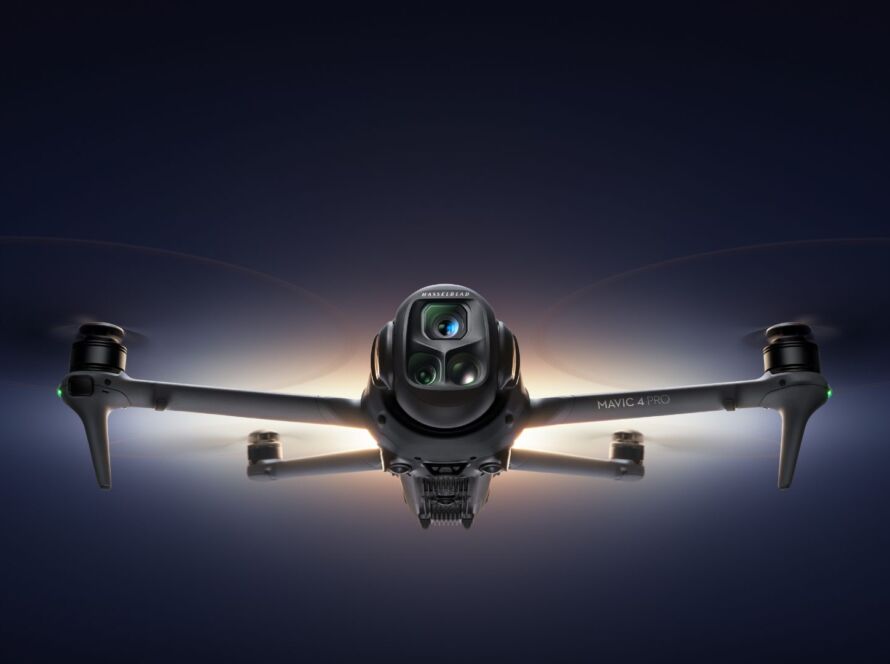
On May 13, 2025, DJI officially launched the Mavic 4 Pro, a drone that immediately established a new benchmark for prosumer aerial imaging. The drone is a technological tour de force, retaining the familiar folding design of the Mavic series while overhauling nearly every key component. It is built around a revolutionary triple-camera system, headlined by a massive 100-megapixel Hasselblad main camera. This is paired with a unique “Infinity Gimbal” capable of a full 360-degree rotation, unlocking creative shooting angles and true vertical video previously impossible on a compact drone.
The video capabilities are equally impressive, with the main camera capturing 6K video at up to 60 frames per second in 10-bit D-Log for maximum flexibility in post-production. Performance is enhanced across the board, with a 51-minute maximum flight time, a 30km HD video transmission range, and a new DJI RC Pro 2 controller featuring a bright, rotatable screen for native vertical shooting. However, this pinnacle of innovation is accompanied by a major blow to the American market. The Mavic 4 Pro is not available for sale in the United States at launch. This absence is a direct consequence of escalating U.S. trade tariffs, which have dramatically increased import costs, and new customs restrictions that have blocked certain DJI shipments over supply chain transparency concerns. This creates a frustrating paradox: DJI has built its most powerful consumer drone ever, but its largest market cannot officially buy it.
Key Takeaway: The Mavic 4 Pro represents the apex of DJI’s consumer drone technology, a statement of its engineering dominance. However, its unavailability in the U.S. starkly illustrates how geopolitical friction can directly halt consumer access to even the most anticipated and innovative technology products, creating a clear divide in the global marketplace.
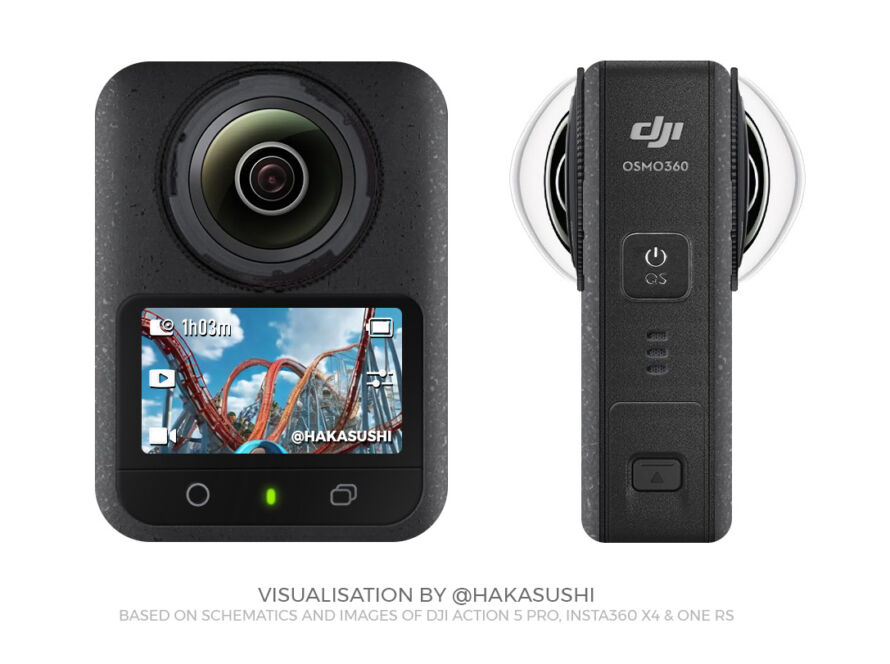
DJI Enters the Sphere: The Osmo 360 Challenges a Crowded Market
DJI Teases “All In One” Osmo 360 Camera for July 31, as Leaks Point to 8K Video and a Showdown with Insta360
DJI has officially released a teaser for a new product launch scheduled for July 31, 2025, featuring the tagline “All In One”. This announcement is widely confirmed to be for the Osmo 360, the company’s first foray into the competitive 360-degree action camera market, a space long dominated by rival Insta360. While official specifications are being held for the launch event, a torrent of extensive and credible leaks—originating from retail packaging, user manuals, and public FCC filings—has painted a detailed picture of a formidable new competitor.
The leaked specifications suggest the Osmo 360 is designed to compete at the very top of the market. It is rumored to feature 8K video recording at 30fps, 10-bit D-Log M color for professional grading, and the ability to capture massive 120-megapixel stitched photos. One of the most talked-about leaks is the claim of a sensor area “equivalent” to that of a 1-inch sensor, which, if it delivers on image quality, would be a significant advantage over the smaller sensors in competing cameras. This aggressive feature set clearly signals DJI’s intention to not just participate in the 360-camera market, but to disrupt it and challenge the incumbent leader directly on flagship specifications.
This launch is more than just a new camera; it represents an ecosystem play. A key differentiator revealed in the leaks is the camera’s native integration with the DJI Mic wireless audio system. While competitors have adequate built-in audio, offering seamless compatibility with a professional-grade wireless microphone system is a powerful draw for the vloggers and content creators who form the core market for these cameras. DJI is not starting from scratch; it is plugging a new piece of hardware into its mature software ecosystem, including the DJI Mimo app, leveraging its reputation for polished hardware-software integration. The Osmo 360’s success may hinge not just on its impressive specs, but on its ability to offer a more holistic and professional content creation solution than its rivals.
Key Takeaway: DJI is leveraging its core competencies in high-quality imaging, stabilization, and ecosystem integration to attack a new product vertical. The Osmo 360 is positioned to disrupt the established leader, Insta360, by competing directly on flagship specs like resolution and sensor size while offering a unique value proposition through pro-audio integration.
The Rumor Mill: Decoding DJI’s Next Moves
Beyond official announcements, the digital grapevine of social media, drone forums, and supply chain leaks provides a tantalizing glimpse into DJI’s future product roadmap. By carefully analyzing the most credible and consistent rumors, a clear picture emerges of the company’s strategic direction for its most popular product lines.
The Sub-250g King Returns: Is the DJI Mini 5 Pro the Ultimate Compact Drone?
DJI Mini 5 Pro Rumored for August Launch with 1-Inch Sensor and LiDAR, Aiming to Pack Pro Power into a Regulation-Friendly Body
The drone community is rife with anticipation for the DJI Mini 5 Pro, with a remarkable consensus among multiple credible sources pointing to a potential launch date of August 7, 2025. The leaks suggest this will be a monumental upgrade, packing features once reserved for drones weighing four or five times as much into its iconic, regulation-friendly sub-250-gram airframe. The rumored specifications represent a paradigm shift for the Mini line. Chief among them is the inclusion of a 1-inch CMOS sensor, a massive leap from the 1/1.3-inch sensor in the Mini 4 Pro, promising a significant improvement in low-light performance, dynamic range, and overall image quality.
This is reportedly paired with front-facing LiDAR for advanced obstacle avoidance, a feature that would dramatically enhance safety and enable more reliable autonomous flight in complex environments. Performance rumors also point to a maximum flight time of up to 50 minutes with an extended battery and a transmission range of up to 25 km, pushing the boundaries of what is possible in such a small package. These upgrades collectively reposition the Mini 5 Pro not as an entry-level or hobbyist drone, but as a serious, compact professional tool that cleverly sidesteps the more stringent regulations applied to heavier aircraft. This leap in capability is expected to come with a corresponding price increase, with rumors placing the base model around $850-$900.
Key Takeaway: The rumored DJI Mini 5 Pro appears to be a strategic masterstroke. By cramming flagship-level performance into a sub-250g body, DJI is aiming to create a new category of “compact professional” drone that delivers maximum capability with minimum regulatory burden, appealing to a vast market of creators and professionals who prioritize both quality and convenience.
New Action and Pocket Drones on the Horizon: Osmo Action 6 and Neo 2 Leaks
FCC Filings Reveal DJI’s Next Moves: Osmo Action 6 and Ultra-Compact Neo 2 Drone in the Pipeline
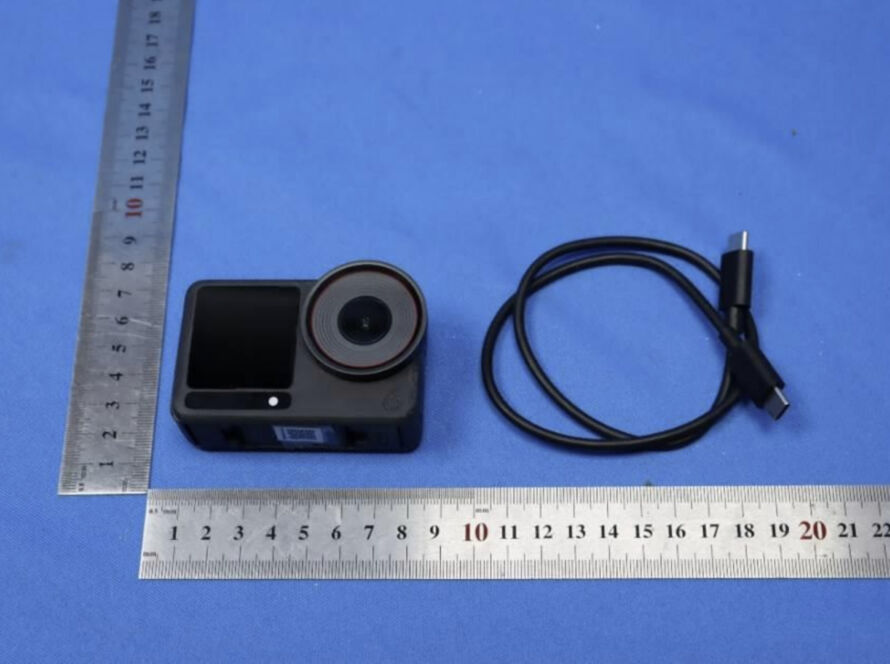
While the Mavic and Mini series command the most attention, regulatory filings and leaks indicate that DJI is actively refreshing its other product lines. The Osmo Action 6, the expected successor to the company’s traditional action camera, has appeared in various leaks. While specifications remain scarce, leaked images suggest a design that largely follows the form factor of the successful Osmo Action 5 Pro, with a potential launch window after the summer of 2025.
More concrete evidence has emerged for the DJI Neo 2, a successor to the ultra-light 135-gram vlogging drone. The Neo 2 has officially passed FCC certification, a necessary step for any wireless device to be sold in the US. The filings reveal a key upgrade: a 1606 mAh battery, which is approximately 12% larger than the 1435 mAh battery in the original Neo, promising to extend its modest 18-minute flight time. However, the Neo 2 perfectly encapsulates DJI’s two-front war. While it has received a technical green light from the FCC, its path to the U.S. market is far from clear. It faces the same potential customs blockades and regulatory headwinds that have kept the Mavic 4 Pro off American shelves.
Key Takeaway: DJI is committed to iterating across its entire product portfolio, from flagship drones to niche vlogging tools. However, the case of the Neo 2 highlights the growing disconnect between technical approval and market access. Receiving an FCC green light is no longer a guarantee of a U.S. launch, creating a state of uncertainty for even minor product refreshes.
Conclusion: The Future of Flight in a Fractured World
The first half of 2025 has unequivocally demonstrated that DJI’s technological momentum is stronger than ever. The launch of the Mavic 4 Pro, the impending arrival of the Osmo 360, and the powerful rumors surrounding the Mini 5 Pro showcase a company at the peak of its innovative powers. Each of these products is not just an incremental update but a significant leap forward, designed to solidify DJI’s dominance in existing markets and aggressively capture new ones. This relentless push for engineering excellence is a clear and effective strategy to outpace the competition.
However, this technological prowess is increasingly operating within the constraints of a fractured geopolitical world. The split availability of the Mavic 4 Pro—a celebrated triumph of engineering that is simultaneously a commercial non-entity in its largest market—is the most potent symbol of this new era. DJI’s future success, particularly in Western markets, will depend as much on its skill in navigating complex legal, political, and trade challenges as it does on its engineering brilliance. Its proactive and transparent security measures are a critical part of this diplomatic effort, but their effectiveness in changing political sentiment remains to be seen.
The remainder of 2025 will be a critical test. Will the highly anticipated Mini 5 Pro enjoy a smooth global launch, or will it face the same hurdles at the U.S. border that grounded the Mavic 4 Pro? Can the Osmo 360, as a first-generation product, successfully challenge an entrenched and respected competitor like Insta360? And most importantly, can DJI’s earnest efforts in data security and transparency begin to turn the tide of political opinion in its most challenging markets? The answers to these questions will shape not only the future of DJI but the landscape of the entire global drone industry for years to come.
Frequently Asked Questions (FAQs)
When is the DJI Mini 5 Pro expected to be released, and what are its key rumored features?
The DJI Mini 5 Pro is widely rumored to be released on August 7, 2025, based on consistent reports from multiple drone-focused news outlets and industry insiders. The key rumored features represent a significant upgrade over its predecessor, positioning it as a professional-grade tool in a compact body. These features include a larger 1-inch CMOS sensor for superior image quality, the integration of LiDAR for advanced obstacle avoidance in low-light conditions, an extended flight time of up to 50 minutes with a “Plus” battery, and a transmission range of up to 25 km. Critically, it is expected to maintain a sub-250-gram weight, allowing it to bypass more stringent drone regulations in many countries.
Why is the new DJI Mavic 4 Pro not available for purchase in the United States?
The DJI Mavic 4 Pro is not available for official sale in the U.S. at launch due to a combination of trade policy and regulatory hurdles. The primary factors are the significant U.S. tariffs imposed on Chinese-made drones, which have substantially increased import costs, making it difficult to price the product competitively. Additionally, U.S. Customs and Border Protection (CBP) has detained certain DJI shipments, citing the Uyghur Forced Labor Prevention Act (UFLPA) and demanding greater transparency in the supply chain. Although DJI maintains its products have no connection to the Xinjiang region, these customs blockades have created significant uncertainty and disruption for importing new models.
How does the rumored DJI Osmo 360 compare to the Insta360 X5?
Based on leaked specifications, the DJI Osmo 360 is positioned to compete directly with the Insta360 X5 by targeting several key areas. The Osmo 360 is rumored to have a larger sensor (a 1-inch “equivalent” vs. the X5’s 1/1.28-inch), capture higher resolution 120MP photos (vs. 72MP), and offer a higher frame rate at 6K resolution (60fps vs. 5.7K at 60fps). A major differentiator appears to be its native integration with the DJI Mic wireless audio system, offering a pro-audio solution. However, the Insta360 X5 has the advantage of a mature software ecosystem, proven durability, IP68 waterproofing without a case, and user-replaceable lenses, which are significant benefits for action sports users.
What is DJI doing to address the security concerns raised by the US government?
DJI has taken several significant, publicly documented steps to address security concerns. The company published a detailed “2025 Security White Paper” that outlines its security architecture. Key measures include using AES-256 encryption for all user data, providing enterprise users with on-premises server options to keep data off the cloud entirely, and running a long-standing bug bounty program to identify vulnerabilities. Most critically for the U.S. market, DJI has updated its software to completely remove the option for American users to sync flight data to any DJI servers, and it stores U.S. user data that is synced on U.S.-based servers.
What are the most significant technological advancements in drones for 2025?
The most significant drone technology advancements in 2025 revolve around autonomy, endurance, and sensing capabilities. These include the mainstream integration of AI-powered flight control for more intelligent pathfinding and automation. The proliferation of LiDAR sensors in consumer and prosumer drones is enhancing obstacle avoidance, particularly in low-light and complex environments. Furthermore, breakthroughs in battery technology and propulsion efficiency are leading to substantially longer flight times, with flagship drones now approaching the 60-minute mark, which significantly improves operational efficiency for both creative and commercial missions.
What is the DJI Neo 2, and why is its FCC filing significant for the US market?
The DJI Neo 2 is the rumored successor to the DJI Neo, an ultra-lightweight (135g) drone designed for vlogging and casual use. Its recent filing with the U.S. Federal Communications Commission (FCC) is significant because it provides official confirmation of the drone’s existence and reveals a key specification: a 1606 mAh battery, which is about 12% larger than its predecessor’s. However, the filing also highlights the current political climate; while FCC approval is a necessary technical step for a product to be sold in the U.S., it does not guarantee that the drone will clear separate and ongoing customs hurdles. The filing may represent a strategic move by DJI to secure necessary regulatory approvals while it still can, given the uncertainty surrounding future permissions.