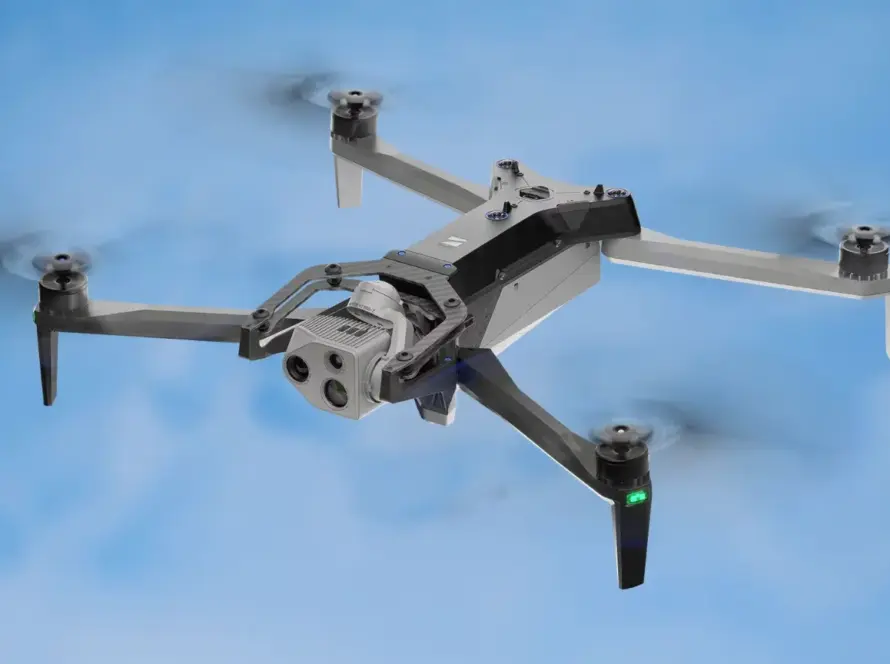
For time-critical industries like search and rescue, disaster response, and tactical defense, waiting hours for post-processing drone data is not an option. Edge AI mapping algorithms are revolutionizing commercial UAV operations by shifting heavy spatial computing directly onto the drone’s hardware. This enables drones to construct real-time 3D models and terrain maps while still in the air, transforming how operators make critical decisions on the ground.
Quick Summary & Direct Answer
Edge AI mapping algorithms utilize powerful onboard microprocessors to process raw camera and LiDAR data mid-flight. By running deep learning models on the drone itself, the system generates real-time orthomosaics, obstacles maps, and path planning, eliminating post-flight computing delays and allowing autonomous operation in remote, disconnected areas.
Technical Mechanics of Onboard Edge Computation
Traditional mapping requires drones to capture thousands of images, save them to an SD card, and upload them to cloud-based servers for photogrammetry processing. Drones running Edge AI mapping algorithms bypass this bottleneck using compact, high-performance graphic processing units (GPUs) mounted directly inside the airframe. As the drone flies, the onboard GPU analyzes pixel data in real time, matching feature points and performing spatial triangulation. This immediate processing generates digital terrain models that are transmitted to the ground control station instantly, enabling rapid situational awareness.
Enabling Autonomous Navigation in GPS-Denied Environments
In environments where GPS signals are jammed or blocked, such as indoor industrial warehouses, deep canyons, or underneath bridges, drones struggle to stabilize. Edge AI algorithms resolve this through visual inertial odometry (VIO) and simultaneous localization and mapping (SLAM). By building a 3D structural model of its surroundings in real time, the drone’s autopilot understands its exact location relative to obstacles. This enables safe, autonomous navigation and obstacle avoidance without relying on external satellite connections, expanding the scope of unmanned operations.
Onboard Edge AI Mapping vs. Cloud-Based Post-Processing
| Workflow Phase | Onboard Edge AI Mapping | Cloud-Based Post-Processing |
|---|---|---|
| Data Delivery Speed | Real-Time (Maps generated and updated during flight) | Delayed (Takes hours to days for processing and rendering) |
| Network Dependency | Low (Operates completely offline on the drone’s processor) | High (Requires internet upload to cloud servers) |
| Model Visual Detail | Medium (Optimized for rapid analysis and navigation) | High (Maximum density 3D meshes and orthophotos) |
Pioneering Real-Time Robotics in Jordan
Jordan’s logistics, emergency services, and security sectors are increasingly adopting automated systems to improve operational speed and safety. Loyalty Drones is at the forefront of introducing Edge AI drone technologies to Jordanian businesses. We configure commercial UAVs with onboard SLAM and real-time mapping capabilities, providing emergency responders and industrial managers in Amman and beyond with rapid, actionable spatial data to handle critical incidents as they unfold, thereby protecting human lives, securing vital national assets, and improving emergency response outcomes.
Partner with Loyalty Drones
Accelerate your spatial operations with real-time onboard mapping. Contact the technical team at Loyalty Drones today.