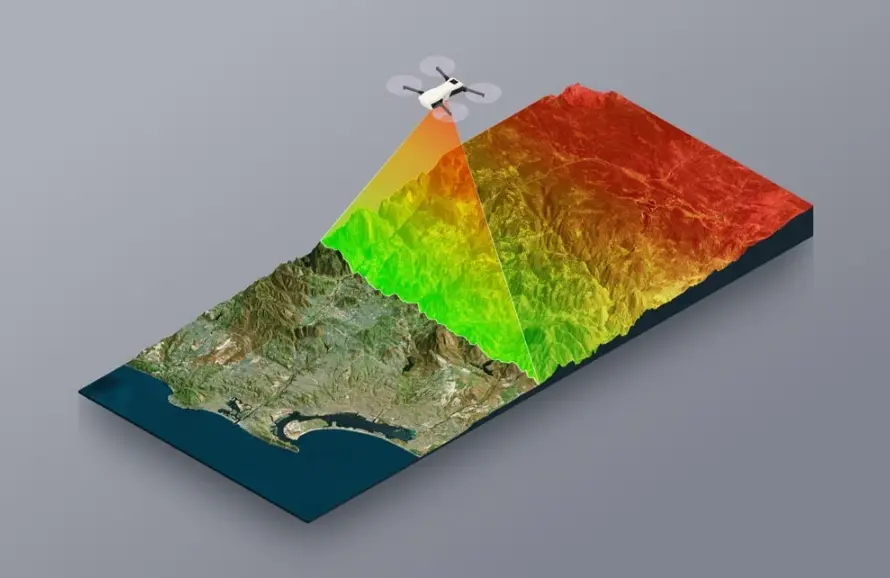
A solar farm drone inspection in Jordan combines a radiometric thermal scan with a high-resolution RGB orthomosaic to locate every failing cell, faulty diode, hot junction and soiled panel across the entire site — with IEC 62446-3-compliant reporting and per-string GPS coordinates. A 50-MW site that took two weeks of ground walking is inspected in a single flight day, with the fault list on your desk within 48 hours.
Why thermal drones beat ground IR walks
- Speed. 5–10 MW per flight hour vs hundreds of metres per hour on foot.
- Coverage. 100% of strings, no skipped tables.
- Angle. Drone IR captures the panel face at the optimum incidence angle.
- Repeatability. Same flight plan every quarter — like-for-like performance comparison.
- Safety. No personnel on live DC strings in direct sun.
What we look for
| Fault | How it shows up | Severity |
|---|---|---|
| Hot cell / single-cell failure | One bright cell in a string | Major |
| Bypass-diode failure | Third of a panel hot | Major |
| Substring failure | Half-panel hot | Critical |
| Module short-circuit | Whole panel hot | Critical |
| Junction-box hot | Hot spot at panel edge | Major (fire risk) |
| Soiling losses | Patches uniformly warm | Minor (cleaning) |
| PID degradation | Whole rows progressively hotter | Critical (system-wide) |
The flight plan we follow
- Plan flight at irradiance > 600 W/m² with site under load.
- Fly RGB orthomosaic at 50 m AGL for context.
- Fly thermal IR at 30 m AGL, nadir, with 75% overlap.
- Process radiometric orthomosaic with anomaly detection.
- Manual QA — every anomaly verified by a thermography-certified analyst.
- Deliver classified report (Critical / Major / Minor) with per-anomaly GPS, string ID and panel coordinates.
What the report contains
- IEC 62446-3-compliant thermography section.
- Site map with anomaly heat-map overlay.
- CSV anomaly list (GPS, string, table, severity, temperature delta).
- RGB+IR pair for each anomaly.
- Performance-loss estimate per fault.
- Recommended remediation priority.
Frequency: how often should a Jordan solar farm be inspected?
Best practice across Jordan’s solar fleet:
- Year 1 (commissioning + EPC handover): baseline inspection within 60 days of energisation.
- Operational years: annual thermal scan minimum; semi-annual on dusty sites (MAFRAQ, Ma’an, Quweira).
- After dust storms or extreme weather: targeted scan within 2 weeks.
- Warranty disputes: immediate independent inspection.
Cost in Jordan (indicative)
From 25 JOD per MW for sites < 50 MW, scaling down for larger fleets. A 100-MW farm typically inspects for 2,000–2,500 JOD all-in. Annual contract pricing available for IPPs with multi-site portfolios.
Why Loyalty Drones
We fly radiometric M3T/M30T thermal payloads, deliver IEC 62446-3-aligned reports, and we know Jordan’s solar belt operationally — MAFRAQ, Quweira, Ma’an, Risha. Related services: drone inspection, surveying and BVLOS operations.
Frequently Asked Questions
What is the minimum site size you inspect?
From 1 MW up to utility-scale 100 MW+. Smaller commercial rooftop arrays are also inspected on a per-site basis.
Can the inspection be done while the plant is operating?
Yes — operating is actually required. The panels must be under load for thermal anomalies to develop visibly.
Do you provide string-level GPS coordinates?
Yes. Every anomaly is tagged with GPS, string ID, table row and panel coordinate so O&M teams find it without re-walking the site.
Is the report acceptable for warranty claims?
Yes. IEC 62446-3-compliant reports with calibrated radiometric data are typically accepted by tier-1 module manufacturers’ warranty processes.
Get a Quote From a CARC-Licensed Jordan Drone Team
Loyalty Drones is a CARC-licensed, fully insured Jordan drone operator serving clients from Amman to Aqaba. Contact us for a free quote within 24 hours, or visit our homepage to see recent work.
Related Drone Services in Jordan
Loyalty Drones is the CARC-licensed team behind every page on this site. These are the services most relevant to this article:
Or browse the full service list on the services hub, or read about us on the About page.